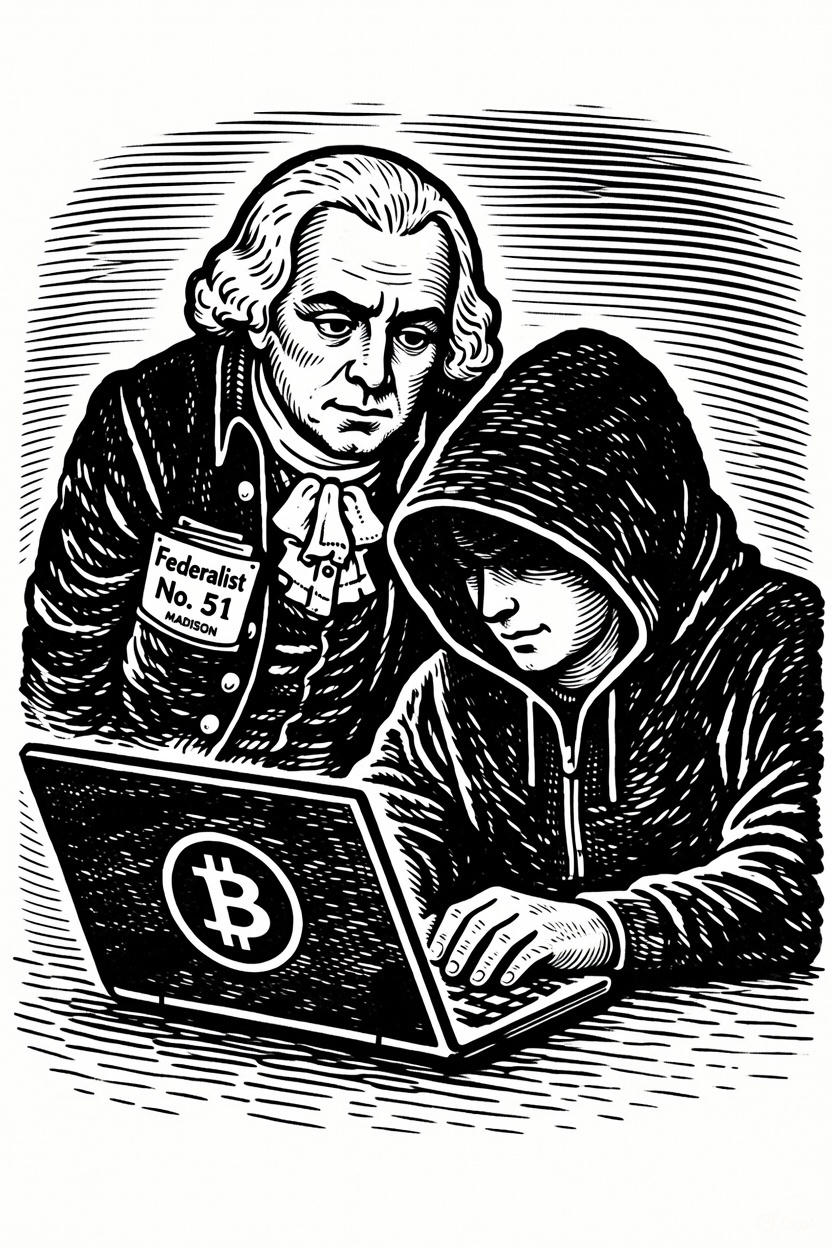
"If men were angels, no government would be necessary... you must first enable the government to control the governed; and in the next place oblige it to control itself."— James Madison, Federalist No. 51 (1788)
The Combined Mechanism
Multi-Signature Authorization
Bitcoin can be sent to addresses requiring multiple keyholders to authorize spending. A 3-of-5 configuration means any three board members must sign. Without sufficient signatures, the transaction is mathematically invalid—no political pressure can override this.
Time-Locked Restrictions
Funds are locked until a specified future date using OP_CHECKLOCKTIMEVERIFY. Like a cryptographic safe with a timer—attempts to spend before the unlock date are automatically rejected by the Bitcoin network as invalid.
Dual Spending Paths
The mechanisms combine to create layered governance: an override path allowing early access with supermajority consent (e.g., 6-of-7), and a standard path becoming available after the time-lock expires with a lower threshold (e.g., 3-of-5).
// Two spending paths encoded in a single Bitcoin script (Taproot structure)

// ═══════════════════════════════════════════════════════════════════════════
// PATH 1: SUPERMAJORITY OVERRIDE (emergency access, bypasses time-lock)
// ═══════════════════════════════════════════════════════════════════════════

OP_IF
    // Requires 6-of-7 board member signatures for immediate access
    6                                // Threshold: 6 signatures required
    <Board_Member_1_PubKey>         // Treasury Director
    <Board_Member_2_PubKey>         // Finance Minister Rep
    <Board_Member_3_PubKey>         // Central Bank Rep
    <Board_Member_4_PubKey>         // Parliament Appointee
    <Board_Member_5_PubKey>         // Opposition Appointee
    <Board_Member_6_PubKey>         // Independent Expert
    <Board_Member_7_PubKey>         // Civil Society Rep
    7                                // Total keyholders
    OP_CHECKMULTISIG                // Verify signature threshold

// ═══════════════════════════════════════════════════════════════════════════
// PATH 2: STANDARD ACCESS (after time-lock expires)
// ═══════════════════════════════════════════════════════════════════════════

OP_ELSE
    // First: Enforce time-lock — funds inaccessible until specified date
    <January_1_2035_Timestamp>      // Unix timestamp: 2051222400
    OP_CHECKLOCKTIMEVERIFY          // Reject if current time < lock time
    OP_DROP                          // Clean stack

    // Then: Requires only 3-of-5 signatures (lower threshold post-lock)
    3                                // Threshold: 3 signatures required
    <Board_Member_1_PubKey>         // Treasury Director
    <Board_Member_2_PubKey>         // Finance Minister Rep
    <Board_Member_3_PubKey>         // Central Bank Rep
    <Board_Member_4_PubKey>         // Parliament Appointee
    <Board_Member_5_PubKey>         // Opposition Appointee
    5                                // Total keyholders (subset)
    OP_CHECKMULTISIG                // Verify signature threshold

OP_ENDIF

// ═══════════════════════════════════════════════════════════════════════════
// RESULT: Separation of powers encoded in mathematics, not policy manuals
// ═══════════════════════════════════════════════════════════════════════════
Interactive Governance Simulator
💰 Fund Allocation
⏱️ Time-Lock Configuration
🔐 Standard Path (Post-Lock)
🚨 Override Path (Emergency)
Real-World Application
Nauru Phosphate Royalties Trust
What Happened
The Trust collapsed from over $1 billion to approximately $300 million as officials spent capital on failed investments and excessive current expenses. Funds were invested in a London musical that advisors themselves were producing. There was no structural barrier slowing the drainage—authorization was discretionary, and political pressure enabled rapid depletion.
With This Mechanism
Time-locked portions of the fund would have been mathematically inaccessible for routine spending. Officials could not have depleted reserves regardless of justifications. Early access would have required supermajority board agreement—near-unanimous consent that the self-dealing advisors could never have obtained. The failed investments might have consumed available capital, but the protected portions would have remained intact for future generations.
1MDB Malaysia
What Happened
The Malaysian Public Accounts Committee found that "key financial and investment decisions were made without reference to or approval of the Board at all." Over $4.5 billion was misappropriated through a web of shell companies. Authorization protocols existed on paper but were routinely circumvented through political pressure and fabricated documentation.
With This Mechanism
Multi-signature control makes board circumvention impossible. No amount of political pressure, fabricated documentation, or institutional capture can create a valid Bitcoin transaction without the required private keys. Each authorization is permanently logged on-chain, creating irrefutable evidence of who approved each transfer. The conspiracy would have required compromising multiple independent keyholders simultaneously—a dramatically higher bar than pressuring a single official.
Why Mathematical Enforcement Matters
Policy vs. Protocol
Traditional governance depends on officials following policies voluntarily. Multi-signature requirements are enforced by the Bitcoin network itself—no discretion, no exceptions. The constraint is architectural, not aspirational.
Permanent Accountability
Every signature is permanently recorded on-chain. Unlike board minutes that can be falsified or meeting records that can be lost, the cryptographic record cannot be altered. Citizens can verify exactly who authorized each transaction.
Balanced Rigidity
Time-locks with no override would be catastrophic if circumstances change. But requiring supermajority override ensures early access demands broad consensus—preserving flexibility while preventing impulsive depletion.
"Ambition must be made to counteract ambition. The interest of the man must be connected with the constitutional rights of the place."— James Madison, Federalist No. 51 (1788)