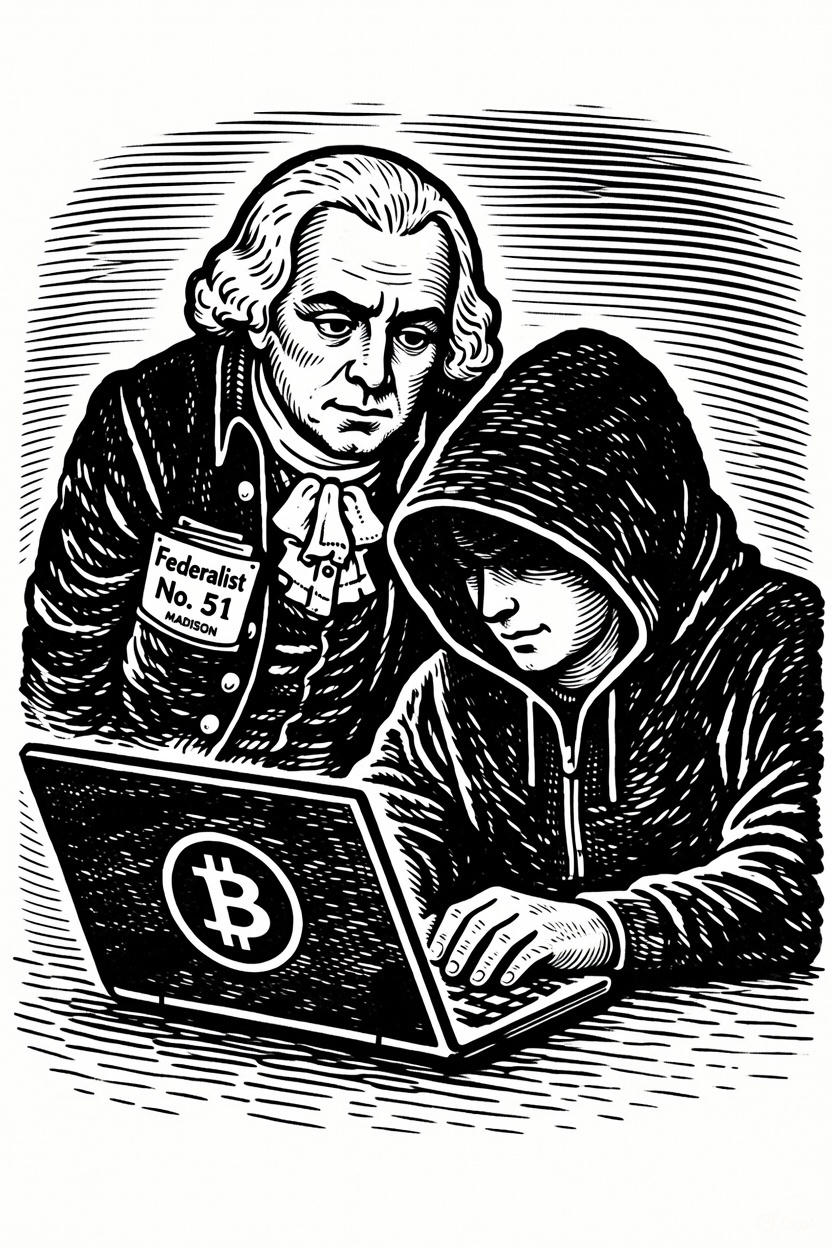
Auxiliary Precautions in Code:
Blockchain Governance for Sovereign Wealth Funds
Madison meets Satoshi
Madison meets Satoshi
Bitcoin's permanent, tamper-proof record makes altering transaction history computationally infeasible. This page explores why immutability matters for sovereign governance by contrasting Bitcoin's absolute commitment to transaction finality with Ethereum's 2016 decision to reverse history.
"In framing a government which is to be administered by men over men, the great difficulty lies in this: you must first enable the government to control the governed; and in the next place oblige it to control itself."— James Madison, Federalist No. 51 (1788)
Rules apply equally to all participants. No transaction, however controversial, has ever been reversed by social consensus. The blockchain is a permanent record.
Smart contracts execute as written, but the community reserves the right to intervene in "extraordinary circumstances." Social consensus can override code.
A decentralized venture fund raises $150M in ETH—the largest crowdfunding in history. Investors receive tokens proportional to their contribution.
An attacker exploits a "recursive call" vulnerability, draining 3.6M ETH (~$60M) into a "child DAO." The funds are locked for 27 days by the contract's own rules.
Ethereum community splits: Some argue code executed as written and intervention would undermine trust. Others argue the clear intent was violated and intervention is justified.
Block 1,920,000: Ethereum implements an "irregular state change" returning DAO funds. ~85% of miners support the fork. The attacker's transactions are effectively erased.
Ethereum Classic continues the original chain. The precedent is set: Ethereum can reverse transactions if enough stakeholders agree. But this power has never been used again.
| Criterion | Bitcoin | Ethereum |
|---|---|---|
| Transactions Reversed | 0 | 1 (The DAO) |
| Immutability Guarantee | Absolute | Conditional |
| Governance Model | No central authority | Foundation-influenced |
| Chain Splits from Reversals | None | 1 (ETC/ETH) |
| Precedent for Intervention | None exists | Exists but unused since 2016 |
The DAO fork illustrates precisely the governance challenge Madison identified: the difficulty of constraining those in power from acting in their own interest, even when that interest aligns with popular sentiment.
Ethereum's founders and major stakeholders had significant holdings in The DAO. When given the choice between accepting a loss according to established rules or changing the rules to recover their funds, they chose the latter. The decision may have been economically rational and even popular—but it established that Ethereum's transaction history is subject to social override.
For a sovereign wealth fund, this distinction matters enormously. Bitcoin's immutability means that once a transaction is recorded, no future administration—however powerful—can alter the historical record. The blockchain serves as a permanent, neutral witness that constrains all parties equally.
This is Madison's "auxiliary precaution" made mathematical: a system where the rules bind everyone, including those who write them.
Bitcoin's immutability allows sovereigns to make credible commitments that future governments cannot undo. A constitutional allocation to a fund can be verified forever.
No participant—not even the protocol's creators—can reverse unfavorable outcomes. Rules apply equally to ministers and citizens alike.
The complete, unalterable transaction history provides auditors, investigators, and citizens with a reliable record that cannot be doctored by those with access to power.
Emergency interventions—however well-intentioned—create precedents. Bitcoin's absolute immutability eliminates the political pressure to "make an exception just this once."